Business Interruption Insurance
Business interruption insurance protects commercial property owners and tenants from financial losses during operational downtime caused by property damage, covering lost income, ongoing expenses, and recovery costs.
What you need to know

How this protects you
Lost profits and revenue protection to restore your financial position
Coverage for ongoing fixed expenses like mortgages, rates, and insurance premiums
Employee wage support to retain valuable staff during closure periods
Relocation costs and temporary operating expenses covered
Rental income protection for landlords when tenants cannot occupy
Extra cost coverage to accelerate your business recovery
Years of experience
Clients protected
5-star reviews
What's covered
Business Interruption insurance provides comprehensive financial support when operations are disrupted due to property damage. For property owners and landlords, coverage includes lost profits and revenue, fixed operating expenses (mortgages, rates, insurance premiums, equipment leasing), employee wages, relocation and temporary operating costs, lost rental income, and property management costs. For tenants leasing commercial space, coverage includes lost business income, ongoing rent payments required by lease agreements, increased costs of working from temporary space, moving and relocation expenses, modifications to temporary premises, customer communication costs, and lost income at temporary locations.
Coverage is triggered by physical damage to your building, denial of access by authorities, damage to neighbouring properties blocking access, supply chain disruptions at key suppliers, and utility failures caused by covered perils. The policy works alongside commercial property insurance – building coverage repairs physical damage while BI coverage protects your financial health during recovery.
When both landlords and tenants have well-structured BI policies, it maintains financial stability for the entire commercial ecosystem, ensuring neither party bears disproportionate financial strain during recovery. This coordinated protection is essential in New Zealand's unique risk environment, where earthquakes, floods, and other natural disasters can cause extended business closures.
Why you need this
In New Zealand, with unique risks from earthquakes, fires, and floods, BI cover is a cornerstone of solid business protection. The money lost and ongoing bills during closure can be far more damaging than physical repair costs. Without proper BI protection, even a temporary shutdown can lead to permanent closure. Throughout the recovery journey, financial commitments keep coming – rent, mortgages, supplier payments – even when normal income has dried up. BI insurance bridges this critical financial gap.
Major events like earthquakes can force businesses to close for years, not just months, making the right cover and indemnity period vital. For commercial property owners and tenants, factors like stringent building codes, contractor shortages, and supply chain issues can drag out recovery times much longer than elsewhere in the world. The Canterbury earthquakes taught many NZ businesses a harsh lesson – those with 12-month indemnity periods often found their coverage expired long before they could reopen or fully recover.
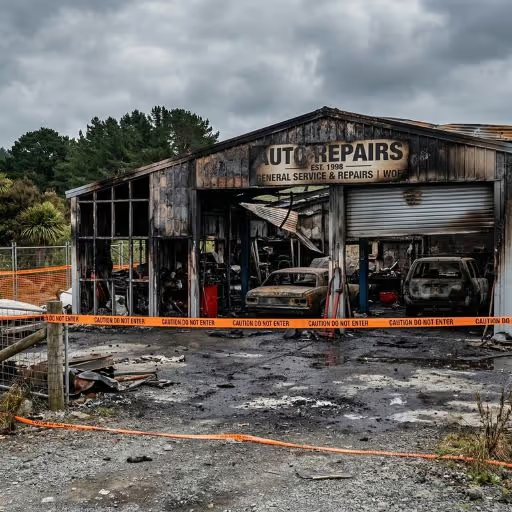
Consider these real-world scenarios: A retail shop damaged by fire may need 18 months to rebuild, get resource consent, complete fit-out, and restore customer traffic. A manufacturing facility hit by flooding could face 24 months of disruption between repairs, equipment replacement, and production resumption. An office building damaged by earthquake might require years for structural assessments, code compliance upgrades, and tenant return. In each case, financial obligations continue relentlessly while revenue streams dry up – BI insurance ensures your business survives to rebuild.
Get Business Interruption Cover in 4 Simple Steps
Protect your business from financial disruption with expert guidance
Assess Your Coverage Needs
We'll evaluate your business income, fixed expenses, seasonal variations, and potential risks to determine the right level of protection for your specific situation.
Compare Policies and Insurers
Review tailored coverage options from 30+ leading insurers to find the best fit for your business. We'll explain indemnity periods, sum insured calculations, and policy features.
Calculate Your Sum Insured
We'll help determine the appropriate coverage amount based on your gross profit, ongoing expenses, growth projections, and chosen indemnity period to ensure adequate protection.
Activate Your Protection
Complete your application and secure comprehensive coverage to safeguard your business against financial disruption. Get instant policy documents and expert ongoing support.
Pricing factors
Business interruption insurance premiums are calculated based on several key factors:
- Type of business - Higher-risk industries with complex operations or longer recovery times typically pay higher premiums than straightforward retail or office businesses
- Sum insured - The total amount of coverage you need directly impacts premium costs. Higher coverage limits for revenue, expenses, and wages result in higher premiums
- Location - Properties in areas with higher natural disaster risk (earthquake zones, flood-prone areas, coastal regions) face increased premiums
- Indemnity period - Longer coverage periods (24 or 36 months vs 12 months) increase premiums but provide essential protection for complex recoveries
- Claims history - Previous business interruption claims can significantly impact pricing, while a clean record may qualify for discounts
- Building construction and age - Older buildings or those with slower rebuild potential affect pricing due to extended recovery timeframes
Business interruption insurance in New Zealand typically costs between 0.1% to 0.5% of the sum insured amount annually.
What our clients are saying
Businesses and families trust us with what matters
What Is Business Interruption Insurance?
Business interruption (BI) insurance — sometimes called business income insurance or loss of profits insurance — is a specialist commercial policy designed to replace lost income and cover ongoing expenses when your business operations are disrupted due to physical damage to your property.
While commercial property insurance pays to repair or rebuild your building and replace damaged contents, it does nothing to compensate you for the revenue you lose while that work is being done. Business interruption insurance fills that critical gap, ensuring your business remains financially viable throughout the recovery period.
For New Zealand businesses, this distinction is more important than almost anywhere else in the world. Our unique natural hazard environment — earthquakes, volcanic activity, flooding, and severe weather events — means recovery periods can stretch far longer than expected. A business that only has property cover may find itself with a repaired building but no operating capital, no staff, and no customers left to serve.
Who Needs Business Interruption Insurance?
Business interruption insurance is relevant to a wide range of commercial operators across New Zealand. If your business relies on physical premises to generate income, you are exposed to business interruption risk. This includes:
- Retail businesses — shops, showrooms, and service-based retailers dependent on foot traffic and a physical location
- Hospitality operators — restaurants, cafes, bars, and accommodation providers for whom closure means immediate revenue loss
- Manufacturers and processors — businesses with complex equipment, production lines, and extended recovery timelines
- Professional service firms — offices housing critical systems, records, and equipment essential to service delivery
- Commercial landlords and property investors — property owners who rely on rental income that disappears when tenants cannot occupy
- Healthcare and medical practices — clinics and practices with specialised premises, equipment, and patient obligations
- Trades and contractors — businesses with workshops, warehouses, or depots central to their operations
Essentially, if your business would suffer financially from being unable to operate at its normal premises, business interruption insurance deserves serious consideration.
What Does Business Interruption Insurance Cover?
A well-structured business interruption policy provides comprehensive financial protection across several key areas:
- Lost gross profit — the revenue your business would have earned during the disruption period, calculated against your trading history and projections
- Fixed operating expenses — ongoing costs that continue regardless of whether you are trading, including mortgage repayments, lease payments, rates, insurance premiums, and equipment finance
- Employee wages and salaries — payroll costs to retain key staff during closure so you don't lose your workforce to competitors
- Increased costs of working — additional expenses incurred to minimise the interruption, such as operating from temporary premises, hiring substitute equipment, or using external service providers
- Relocation and fit-out costs — moving to and modifying a temporary location to continue some or all operations
- Rental income loss — for commercial landlords, lost rental income when tenants cannot occupy the property due to damage
- Property management costs — additional management fees and costs associated with managing a damaged or partially occupied property
Coverage is triggered when a defined insured event causes physical damage to property that results in a reduction in your business turnover. Common triggers include fire, flood, storm damage, earthquake, impact damage, and malicious damage.
Understanding Indemnity Periods
One of the most important — and most frequently misunderstood — aspects of business interruption insurance is the indemnity period. This is the maximum length of time for which the policy will pay out following a covered event.
Standard indemnity periods offered in New Zealand are typically 12, 18, 24, or 36 months. Choosing the right indemnity period is critical, and the Canterbury earthquakes provided a stark lesson for many NZ businesses: those who chose 12-month indemnity periods often found their coverage had expired before they were able to reopen, complete their rebuild, or restore their customer base.
When selecting your indemnity period, consider the following factors:
- Building rebuild time — in New Zealand, engineering assessments, resource consent, and contractor availability can significantly extend rebuild timelines beyond initial estimates
- Equipment lead times — specialist plant, machinery, or imported equipment may have long delivery and installation timelines
- Regulatory compliance — upgraded building codes following a major event may require significant additional work beyond simple reinstatement
- Customer and market recovery — even once physical premises are restored, rebuilding customer relationships, supply chains, and market position takes time
- Your industry's complexity — a simple retail shop and a food processing facility have very different recovery timelines
At Gerrards, we strongly recommend most New Zealand businesses consider a minimum 24-month indemnity period, with 36 months appropriate for businesses in high-risk seismic zones or those with complex operations.
How Is the Sum Insured Calculated?
Calculating the correct sum insured for business interruption insurance is more involved than for property insurance, and getting it wrong is a common — and costly — mistake. Underinsurance in BI policies can leave you with a significant financial shortfall at the worst possible time.
The sum insured for a BI policy is typically based on your business's gross profit — broadly, your turnover minus variable costs (the costs that would cease if your business stopped trading). This is multiplied by your chosen indemnity period to arrive at the sum insured.
For example: if your business generates $500,000 in gross profit annually and you choose a 24-month indemnity period, your sum insured should be approximately $1,000,000.
However, the calculation is rarely this straightforward. Factors to account for include:
- Business growth projections — your sum insured should reflect where your business will be during the indemnity period, not just where it is today
- Seasonal fluctuations — businesses with significant seasonal revenue peaks need coverage that accounts for worst-case timing of a loss event
- Wage protection requirements — if wages are to be covered separately, the sum insured should be structured accordingly
- Fixed expenses treatment — ensuring all ongoing fixed costs are captured correctly in the gross profit calculation
Gerrards' brokers work through this calculation with you carefully, drawing on your financial records and business forecasts to ensure your coverage is adequate.
Triggers and Extensions: Beyond Standard Coverage
Modern business interruption policies can be extended well beyond the basic trigger of direct physical damage to your own property. Depending on your business's vulnerabilities, the following extensions may be available and worth considering:
- Denial of access — coverage when authorities deny access to your premises following a nearby event, even if your own property is undamaged (common following earthquakes or chemical spills)
- Contingent business interruption — protection when a key supplier's or customer's premises are damaged, disrupting your own operations
- Utility failure — coverage for business interruption caused by failure of electricity, gas, water, or telecommunications supply due to damage at the supplier's infrastructure
- Prevention of access — notifiable disease — some policies can extend to include interruption caused by contagious disease at or near your premises
- Damage to nearby property — interruption caused by damage to neighbouring properties that prevents customers from reaching you
Not all extensions are available from all insurers, and the specific wording of your policy matters enormously. An experienced broker can identify the extensions most relevant to your business and negotiate appropriate coverage terms on your behalf.
Business Interruption for Commercial Landlords
Commercial property investors and landlords face a distinct set of business interruption risks compared to owner-occupiers. When a building is damaged and tenants are unable to occupy, rental income stops — but mortgage repayments, rates, insurance premiums, and property management costs do not.
Rental income protection under a BI policy for landlords typically covers:
- Lost rental income for the duration of the indemnity period while the property is being reinstated
- Lost rental income where tenants exercise break clauses in their lease due to the damage
- Property management costs that continue or increase during the recovery period
- Additional costs incurred to minimise the rental income loss, such as temporary accommodation for displaced tenants
Landlords should ensure their rental income sum insured reflects current market rental rates plus an allowance for increases over the indemnity period, and that their indemnity period is sufficient to cover the full rebuild and re-leasing process — not just the physical reinstatement.
Business Interruption for Commercial Tenants
Tenants in commercial premises face their own BI exposure, independent of whether they own the building. If a landlord's building is damaged and you can no longer operate from your leased premises, your lease agreement may still require you to pay rent — even while you're generating zero income.
A BI policy for tenants should cover:
- Lost business income during the period of displacement
- Ongoing lease payments required under the terms of your tenancy agreement
- Costs of operating from temporary premises, including fit-out modifications
- Moving and relocation expenses
- Additional marketing and customer communication costs to manage the disruption
It's worth noting that a landlord's policy protects the landlord's interests — not yours. As a tenant, you need your own business interruption coverage in place to protect your own financial position.
The New Zealand Risk Environment
New Zealand's geographic and geological characteristics create a business interruption risk profile unlike most other countries. Understanding these risks helps inform the right level of coverage for your business.
- Seismic activity — New Zealand sits on the boundary of the Pacific and Australian tectonic plates, making it one of the world's most earthquake-prone nations. The 2010-2011 Canterbury earthquakes caused extended business closures measured in years, not months.
- Flooding — increasingly frequent and severe flooding events across the North and South Islands have caused significant commercial property damage and extended closures in recent years, including the 2023 Auckland Anniversary Weekend floods and Cyclone Gabrielle.
- Fire — commercial building fires remain one of the most common triggers for business interruption claims, and in many regional areas, fire risk is elevated by proximity to agricultural land or forestry.
- Severe weather — wind, hail, and snow damage events cause regular commercial property disruption, particularly in southern and central New Zealand.
- Infrastructure fragility — New Zealand's relatively concentrated infrastructure means that damage to key roads, bridges, or utilities can prevent access to commercial premises even when the premises themselves are undamaged.
These factors reinforce why business interruption insurance is not optional risk management for serious NZ business operators — it's an essential component of any comprehensive commercial insurance programme.
Common Business Interruption Claims in New Zealand
Understanding how claims play out in practice can help business owners appreciate the real-world value of BI coverage. Common scenarios include:
- Fire at retail premises — a fire requiring 18+ months of rebuild, during which the business must pay rent on temporary premises, retain staff, and absorb marketing costs to maintain customer relationships
- Flood damage to a restaurant — water damage requiring extensive kitchen and fitout restoration, during which all revenue ceases but lease payments, supplier contracts, and staff costs continue
- Earthquake damage to an office building — structural assessments, engineering remediation, and code compliance upgrades extending closure for 2+ years, with the business needing to operate from temporary space throughout
- Denial of access following neighbouring building collapse — a business that is physically undamaged but unable to trade because authorities have cordoned off the surrounding area
- Key supplier fire — a manufacturer whose primary component supplier suffers a fire, halting their own production for months
In every case, the businesses with adequate BI coverage — the right sum insured and a sufficient indemnity period — were able to emerge from the disruption intact. Those without it frequently did not.
Why Choose Gerrards for Business Interruption Insurance?
At Gerrards Insurance Brokers, we specialise in commercial insurance for New Zealand businesses. Our team of experienced brokers understands the unique risk environment facing NZ operators and the complexity of business interruption coverage.
Unlike going direct to an insurer, working with Gerrards gives you access to the full market — including 30+ leading insurers — and the benefit of independent, expert advice. We work for you, not for the insurer.
Our brokers will take the time to understand your business, calculate the right sum insured, recommend an appropriate indemnity period, and identify extensions that match your specific vulnerabilities. We'll also review your coverage at each renewal to ensure it keeps pace with your business's growth and evolving risk profile.
When a claim occurs, our team advocates on your behalf to ensure you receive the full entitlement you're owed — not just what the insurer initially offers. That advocacy is often worth more than the cost of our advice many times over.
Get in touch with Gerrards today for a same-day quote on business interruption insurance tailored to your commercial operation.
Related FAQs
The answers that matter when you're deciding on coverage.
Your building coverage repairs the physical damage, while business interruption coverage protects the financial health of your operation during recovery. The two policies work in tandem – property insurance fixes the building, and BI insurance ensures your business survives financially during that recovery period.
Coverage is triggered by physical damage to your building, denial of access by authorities, damage to neighbouring properties blocking access, supply chain disruptions at key suppliers, and utility failures caused by covered perils.
For tenants leasing commercial space, BI insurance covers lost business income, ongoing rent payments required by lease agreements, increased costs of working from temporary space, moving and relocation expenses, modifications to temporary premises, customer communication costs, and lost income at temporary locations.
For property owners and landlords, coverage includes fixed operating expenses such as mortgages, rates, insurance premiums, equipment leasing, employee wages, lost rental income, and property management costs that continue even when normal income has stopped.
Major events like earthquakes can force businesses to close for years, not just months, and factors like stringent building codes, contractor shortages, and supply chain issues can drag out recovery times. The Canterbury earthquakes showed that businesses with 12-month indemnity periods often found their coverage expired long before they could reopen or fully recover.
Protect Your Business from Financial Disruption
Same day quotes with access to up to 30 insurers. Expert advice for your commercial property.